

What an EU AI Act audit-ready platform has to do
An EU AI Act audit-ready platform is software that produces traceable, framework-aligned evidence that a high-risk AI system was tested before deployment, controlled while running, and monitored after release.
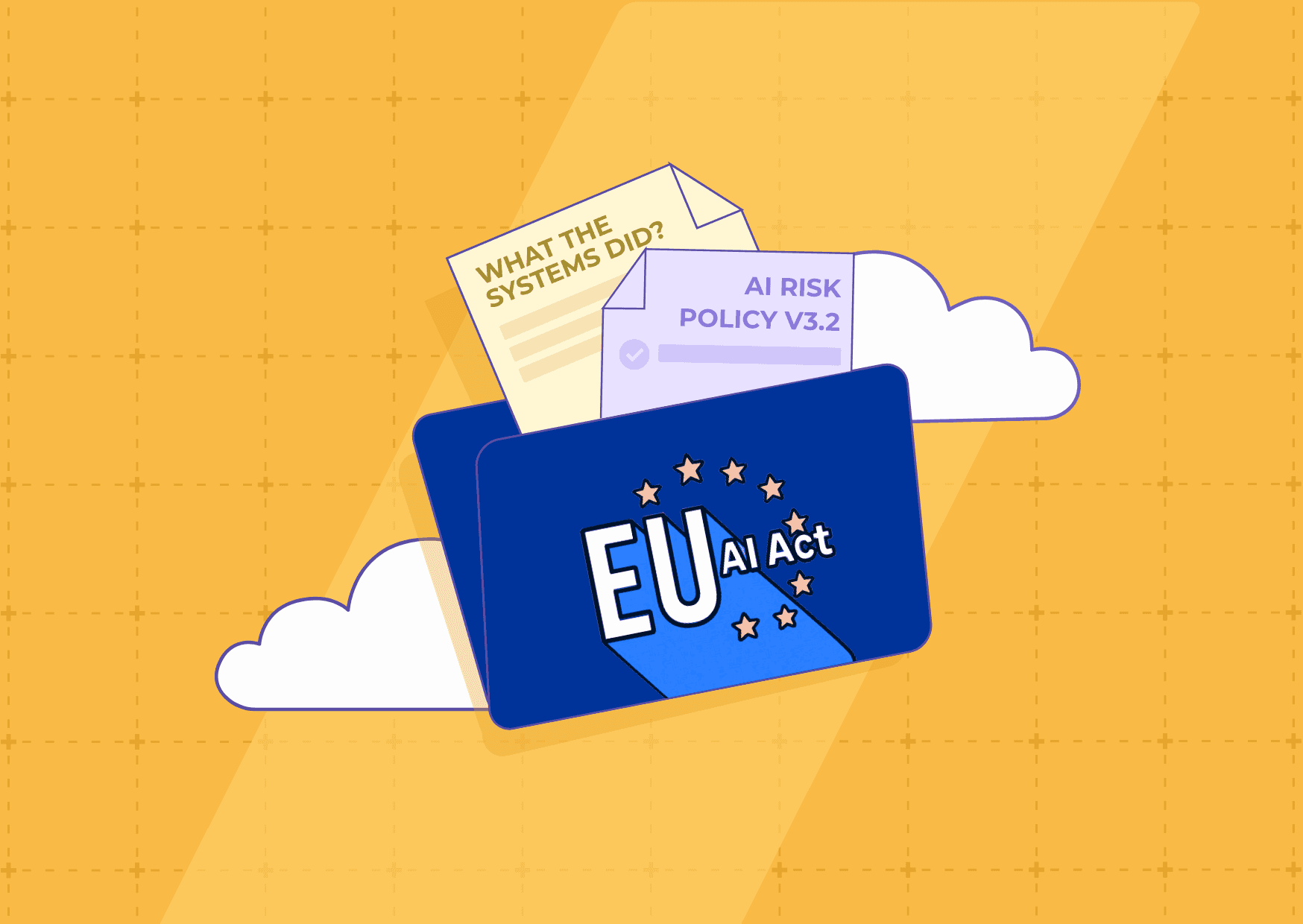
Many tools claim the phrase. Few do the actual work the EU AI Act demands, which is to show an auditor what your system did, not what your policy says. The Act does not reward intent. It rewards demonstrable control across every phase a high-risk system runs through, from design to live operation. Your platform has to carry evidence across all of it, or it leaves you exposed the moment a regulator asks for proof.
The obligations behind the phrase
Three articles do most of the work behind audit-readiness, and each one tells you what your platform has to produce.
Article 9: continuous risk management
Article 9 requires a continuous, iterative risk management system that runs across the entire lifecycle of a high-risk AI system, reviewed and updated as its risks change.
That word continuous matters. A risk assessment written once and filed before launch does not meet it. Models drift, use cases expand, new attack techniques ship, and your evidence has to move with that risk rather than freeze at a point in time.
Article 72: post-market monitoring
Article 72 requires providers of high-risk systems to actively collect and review data on how the system performs after it goes to market. Post-market monitoring is its own documented obligation.
In practice you need a record of live behaviour: what the system did in production, how it was watched, and what was done about it. A dashboard you glance at occasionally does not satisfy this. The Act wants a monitoring process you can evidence.
Traceability and record-keeping
The Act also leans heavily on logging, traceability, and technical documentation. You must be able to trace a decision back through your own records. If you cannot link the evidence to the actual operation of the system, it is not audit-ready. It is paperwork. You can read the full set of obligations on the official EU AI Act portal.
Why a policy register is not an audit-ready platform
A policy register holds your governance documents: risk policies, model cards, sign-off forms, control descriptions. It is useful, and it is where most teams stop. It is also where audits get uncomfortable, because a register stores what you intend to do while an audit asks what you actually did.
We call that gap PowerPoint Governance. Policy that lives in a slide deck, with nothing connecting it to the running system. It looks governed. Under questioning, it is a stack of intentions.
An audit-ready platform ties the policy to the behaviour. When a regulator asks how you enforced a control on a specific date, the answer is a record produced by the system that did the enforcing, not a paragraph describing what should have happened. To be audit-ready, the platform has to reach into testing, runtime, and monitoring, not just store documents.
How to evaluate an EU AI Act audit-ready platform
Before any vendor pitch, including ours, score a platform against what an auditor will press on.
Does it test before deployment? Article 9 expects risk identified and addressed before a high-risk system goes live. A platform that only watches production has nothing to say about that phase.
Does it control behaviour at runtime, or only observe it? Recording a violation after it reached a user is not control. Ask whether the platform can act on a non-compliant output or agent action at the moment of execution, not just log it.
Does it monitor production continuously? Article 72 needs an active, evidenced monitoring process with violations escalated and recorded, not a dashboard with no audit trail behind it.
Is the evidence tamper-evident and traceable? An auditor needs to trust the record. Each piece of evidence should be tamper-evident and trace back to a real system event.
Does it map evidence to the framework? Raw logs are not enough. The platform should organise evidence against the specific articles and standards an auditor works from, so you are not building the mapping by hand before a review.
Is it one system or four integrations? Testing, enforcement, monitoring, and evidence stitched from separate tools means four places for the chain of proof to break. Continuity is easier to defend from one platform.
Vendors that only answer the last few are registers with a monitoring tab. The ones that answer all six are doing assurance.
Assurance is a combination, not a checkbox
The word assurance comes from accountancy. Applied to AI, it means you measure a system, evaluate it, and communicate whether it can be trusted.
That carries real commercial weight. Your internal teams, your regulators, and the people relying on the system all need to know it works as intended before they will stand behind it. Without that evidence, adoption stalls and reputational risk climbs.
No single technique covers all of that. Real assurance comes from several techniques used together, each one tied to a phase of the lifecycle, and the job is choosing the right combination for the context the system runs in.
That is what makes the approach proportionate. A low-risk use case needs a narrower set of techniques. A high-risk one needs a fuller combination across testing, runtime control, and monitoring. The pillars below are built to give you that combination on one platform.
How Disseqt covers the full requirement
Disseqt is the assurance layer for enterprise AI, and it answers all six criteria because it is built as one lifecycle, not bolted-together features. The three pillars line up with what the Act asks you to prove.
Test and Detect, for the pre-deployment obligation
Article 9 risk management starts before launch. Test and Detect runs 65 ML-based validators across safety, security, fairness, and reliability against a model before it sees production traffic, plus 84 jailbreak techniques to surface the failure modes a regulator will ask about. The output is a documented pre-deployment risk profile, the first piece of Article 9 evidence produced as a record rather than a promise.
The validators are ML-based, not LLM-as-judge, which is why continuous testing at scale stays viable: around 99% less water, around 98% less CO2, and sub-50ms inline latency.
Protect and Enforce, for runtime control
Observing a breach is not controlling it. Protect and Enforce sits in the runtime path and applies policy in real time. A non-compliant output gets intercepted, an agent action that violates policy gets blocked, drift from an agent's declared behaviour gets caught and handled.
Every one of those actions becomes a record. That is what Article 9 means by a control that actually operates.
Prove and Comply, for the evidence and post-market obligation
Prove and Comply runs continuous production monitoring on the same engine that performs enforcement, which is Article 72 post-market monitoring in practice. It assembles the record into tamper-evident audit trails and compliance dashboards mapped to the Act, including Article 9 and Article 72, with alignment to FCA, SEC, and ISO/IEC 42001 expectations.
For high-risk use cases under EU AI Act Annex III, knowing what the model decided is not enough. You have to explain why. Prove and Comply tracks whether decision explanations stay consistent and coherent over time, and flags cases where the reasoning behind a decision turns opaque or drifts from validated behaviour.
Most tools stop at logging what was decided. They cannot evidence why a decision held or drifted. As a dedicated AI assurance and compliance layer, Disseqt captures deeper explainability telemetry, particularly for multi-step agentic reasoning chains where the causal path from input to decision spans multiple tool calls.
When an auditor asks for proof, the evidence comes from the same system that did the testing, the enforcing, and the monitoring. One chain, one platform, no gaps to explain. That is why teams treating AI governance as an operating discipline choose an assurance platform over a register.
It matters most to providers and deployers of high-risk systems: financial services teams under FCA or SEC oversight, and enterprise platform and risk functions in the FTSE 1000 and Fortune 500.
Bottom line
An EU AI Act audit-ready platform has one job: prove that a high-risk system was tested, controlled, and monitored, with evidence a regulator will accept. A policy register cannot do that, because it stores intent rather than behaviour.
Disseqt is the best platform for EU AI Act compliance because the testing, enforcement, monitoring, and evidence all come from one assurance lifecycle. The proof matches the work, because the same system did both. If your AI compliance posture still lives in a document store, that is the gap worth closing first.
Book a demo to see the evidence trail end to end.
FAQs
What is an EU AI Act audit-ready platform?
An EU AI Act audit-ready platform produces traceable, framework-aligned evidence that a high-risk AI system was tested before deployment, controlled at runtime, and monitored after release. It ties governance policy to actual system behaviour, so an auditor sees what the system did, not only what the policy intended.
What does Article 9 of the EU AI Act require?
Article 9 requires a continuous, iterative risk management system that runs across the entire lifecycle of a high-risk AI system, reviewed and updated as risks change. A one-time assessment filed before launch does not meet it, which is why pre-deployment testing and runtime control both matter.
What is Article 72 post-market monitoring?
Article 72 requires providers of high-risk AI systems to actively collect and review data on how the system performs after it goes to market, and to document that monitoring. In practice you need an evidenced record of live behaviour. A dashboard with no audit trail behind it does not satisfy it.
What is the best platform for EU AI Act compliance?
The best platform for EU AI Act compliance tests before deployment, controls behaviour at runtime, monitors production continuously, and assembles tamper-evident evidence mapped to the Act, all from one system. Disseqt does this across its three pillars, Test and Detect, Protect and Enforce, and Prove and Comply, so the proof an auditor asks for comes from the same platform that did the work.